skip to main |
skip to sidebar
This late 19th century haveli (mansion) is located in Jaisalmer (State: Rajasthan). The interior as well as exterior of this haveli is carved magnificent. The designers exhibited high level of quality and skill in executing the massive haveli. (Click on images for bigger view)
 Even though it is built with a single building plan, the architectural brilliance is such that the two wings were built differently. However, the two wings seem to have faultless harmony.
 The carvings on the window are carved out with great precision. The walls are ornamented with stone figurines of horses, flowers, birds, elephants and interesting patterns that resemble extravagant pieces of art.
Lalgarh Palace is located outside the Bikaner city limits. It is at a distance of 3 kms from the city. This palace was built between 1902 and 1926 by Maharaja Ganaga Singh in the memory of his father, Maharaja Lal Singh. (Click on the image for bigger view)
 The architecture of the palace is Indo-Saracenic where one can see elements of Rajput, Muslim and European styles.
 Now, this palace has been converted into a heritage hotel. But, the first floor of the palace is converted into a museum, the Shri Sadul museum. The museum has on display are artifacts and personal possessions of the Bikaner Maharajas.
From Jaisalmer (State: Rajasthan) at a distance of 42 kms is a popular spot in the desert is Sam (State: Rajasthan). People go to this place to watch sunset. (Click on the image for bigger view)
 One can reach this place by driving on the road. Other most popular means of transport is camel safari.
Government of India on 14th October 2009 released two stamps on the Jain Heritage Temples - Ranakpur Temple and Dilwara Temples. Each of these stamps are of denomination Rpees 5.
 I visited both these temples in December 2004, when I toured the State of Rajasthan.
Ranakpur Temples: Located in Ranakpur (State: Rajasthan) this 15th century temple is famous world-wide for their intricate and superb architectural style. This temple is wholly constructed in light colored marble covering an total area of 48000 sq feet. There are more than 1400 exquisitely carved pillars that support the temple. (Click on the image for bigger view)
 Dilwara Temples: Located in Mount Abu (State: Rajasthan) these temples of 11th to the 13th century AD are world famous for their minutely carved ceilings, doorways, pillars and panels in marble. The specialty of these temples is externally they look very plane. This temple is on World Heritage Monuments list.
During our visit to Jodhpur (State: Rajasthan) we planned to visit Umaid Bhavan Palace, after the tour of the Jodhpur fort. We reached this place at 6 p.m and the gates were closed for us. If one wishes to visit this place be here before 5 p.m. After 5 p.m the gates are closed for visitors and they are allowed nowhere near the gates.
 Constructed of marble and pink sandstone this immense palace is also known as the Chhittar Palace because it uses local Chittar sandstone. Begun in 1929, it was designed by president of the British Royal Institute of Architects for Maharaja Umaid Singh and took 15 years to complete.
 This palace is outside the fort and now converted into a luxury hotel. The above snaps was taken from the fort.
This is one of the numerous paintings one can shop in the markets Rajasthan (click on the image to see the bigger image).
 The above painting depicts romance in the sand dunes of the desert.
Shekhawati region in western India, is famous for its mural paintings. It is like a huge open air gallery of painted walls, havelis and palaces in the vast expanse of the desert of Rajasthan in India. Every nooks and corner of the each town, street, home has been painted with frescoes. The homes built by the people of the region feature exquisite paintings that decorate their walls, doors, and interiors. The themes of these frescoes depict gods, kings, flowers and scenes from daily life. (Click on the images for bigger picture)
 The technique of Fresco painting in Shekhawati is very similar to the Italian Fresco technique of the 14th century. Mostly vegetable pigments were used for coloring. Some of the main ingredients are kajal for black, lime for white, neel for blue, geru for red, kesar for orange, yellow clay for yellow.
 The above image is interior courtyard of haveli in Mandwa taken in the night. This technique has been used since 1580 in this region. So this paintings in this area are around this period.
The journey of 10 days across the Royal Land that started from Mandwa ended in Jaipur. The exiting moments we had in the different cities of Rajasthan that we passed through was never ending. Each of the cities had their own uniqueness. I have already written about these places in my prvious postings. Just to summerise what we had covered in these places:
Mandwa known for beautiful fresco paintings through out the place. Bikaner, the camel country known beautiful fort - palace and the marble cenotaphs. Kumbalgarh known for biggest fort in India. Jodhpur, the blue city known for hilltop fort and palaces. Jaisalmer known for Golden fort, Jain temples and huge number of palaces. Ranakpur famous for the carvings of Jain temple. Mount Abu the only hill station of Rajasthan and home for famous Jain temple with exquisite carvings. Udaipur known for the fort, temple and the lake palace. Jaipur known for numerous forts and palaces.
 After covering more than 80% of Rajasthan there is still more to cover. The next trip to this Royal state would explore some parts of Udaipur and Jaipur that could not be done due to lack of time. Other exiting places in the state to travel would be Kota, Bundi, Ajmer, Pushkar, Chittorgarh, Osian, Alwar, Ranthambore etc.,
But for now I have set my eyes on another beautiful state of India - Madhya Pradesh. Since, I have already done it, I will share with you all my friend very soon.
So far in Jaipur we have covered palaces, and other attractions. We also explored three different forts - Nahargarh Fort, Jaigarh Fort and Amber Fort. Apart from these another important place in Jaipur is Jantar Mantar. Thia when translated into English stands for Calculation Instruments.
It is a observatory with collection of architectural astronomical instruments. In 1728 then Maharaja of Jaipur Maharaja Sawai Jai Singh-II had got this place constructed in 7 years. Himself being a keen follower of astronomy, not only did the masonry instruments suit his purposes, they also satisfied his architectural instincts.
 It severed the dual purpose of verifying astronomical observations as well as to stimulate interest in astronomy. It was built keeping in mind the rules of astronomy, the position of the equator, latitudes and longitudes. The observatory consists of fourteen major geometric devices for measuring time, predicting eclipses, tracking stars in their orbits, ascertaining the declinations of planets, and determining the celestial altitudes and related ephemerides.
 Samrat Yantra
This observatory is one of the 5 he had created in his time across the nation. Other popular observeatory is in Delhi. But one here in Jaipur is largest.
P.S: December is the month when lot of tourists land in Rajasthan. So if you really want all the arrangements to be done properly this has to be done before October end.
This is one of the numerous paintings one can shop in the markets Rajasthan (click on the image to see the bigger image).
 The painting here depicts how a normal day in a village may look like.
Through this post, I would also like to thank Hazel of Delineating Des for her kind gesture of "Kreativ Blogger Award".
This is one of the numerous paintings one can shop in the markets Rajasthan.
 The painting here depicts a lady waiting for her man to return from the field who has gone to the farm to earn the bread.
Along with palaces, and other attractions we set our eyes on exploring the most important tourist attractions of the city i.e., the forts. The third fort in Jaipur we followed after the Nahargarh Fort and Jaigarh Fort is Amber Fort.
Built in 1592 on barren ridge by Raja Man Singh, it is one of the finest examples of Rajput architecture. It provides impressive views over a deep narrow valley and the wider plains beyond. It is located on the hills that surround Jaipur. The fort that sprawls along the Maotha Lake, is composed of a massive complex gateways, courts, stairways and pillared pavilions, and palaces.
 From the bottom of the hill one can reach the fort over the hill either by using stairways or elephant ride. For a nominal fee they carry two to three people on elephant to the top where front courtyard of the complex exists.
 The entire fort complex, is constructed of white and red sandstone. The imposing rugged outlook of the fort is of the stark contrast to to the inside, a lavish ornate interior which is combination of both Hindu and Mughal styles of architecture. Some of the interior walls of the fort are covered with murals, frescoes, and paintings depicting various scenes from daily life. Other walls are covered with intricate carvings, mosaic, and minute mirror work. The front yard is adorned with the marvelous, pillared hall of the Diwan-i-Am, and the two - tiered painted gateway Ganesh Pol. Once you enter through the Ganesh Pol, the structure of special interests inside are Sheesh Mahal, Jas Mandir.
 Ganesh Pol in the front yard
 Sheesh Mahal
Along with palaces, and other attractions we set our eyes on exploring the most important tourist attractions of the city i.e., the forts. In Jaipur there are 3 most amazing forts - Amber Fort, Jaigarh Fort and Nahargarh Fort. In this as the title of the post suggests we will explore Nahargarh Fort.
This fort is also known by the name Tiger Fort. When seen from the air it forms marvelous sight along with other two forts. It occupies the Northern part of Jaipur on the Aravalli Hills. It is strategically placed to cushion Amer from the enemy attacks.
According to the legend, this fort was named after a dead Rathore prince, Nahar Singh, whose spirit used to haunt the site and would cause collapse of the construction of the fort. Later a Tantrik's prayer was arranged to drive away the spirit, who agreed to leave on the condition that the fort should be named after him. Hence the name. The entrance of the fort leads one into spacious and impressive main courtyard, with large ‘dwars’ on both sides embellished with decorative motifs of elephants, warriors on horseback, flowers and birds. There are also weather-worn cannon carriages that have faced the ravages of time.
The Monsoon Palace
 This palace was designed by eminent Bengali architect Vidyadhar Bhattacharya. Built in two floors, the ground was for summer and the first floor for winter residence. It has nine suites, one for each of the nine queens of the maharajah. There are bathrooms, toilets, and kitchens, all well-lit and ventilated. An interesting feature is the long and architecturally elegant, but narrow, corridors, some with windows overlooking the main courtyard. It is believed that the these corridors were used by the maharajah to access each queen independently without the others having knowledge of his whereabouts, but hopeful of a visit nevertheless!
 The doors and windows had colored panes, some of which are still intact. And some of the rooms still have Belgian mirrors adorning the walls. Even the brass door latches work. Each suite has the same design of floral and bird motifs. Even the hooks used for hanging the manually operated fans have painted designs to blend with those on the arches and in the niches. The plaster on the walls is of limestone, clean and smooth.
 This is the top of the various suites of the palace.
Next we will explore the Jaigarh Fort.
P.S: December is the month when lot of tourists land in Rajasthan. So if you really want all the arrangements to be done properly this has to be done before October end.
After visiting many palaces of the city, we continued to explore the city and visited quite a lot of forts and other monuments of the city. As we did not spend much time for shopping on the trip we thought of shopping in the city of Jaipur.
In Rajasthan this is the best city to do the shopping. There are many markets known for the art and craft of Rajasthan. Some of them are Kishanpol Bazar, Haldiyon Ka Rasta, Mahiharon Ka Rasta, M.I. Road, Jauhari Bazar, Bapu Bazar, Nehru Bazaar. Each of these markets offer wide variety of products. Explaining the variety does not make any sense and best enjoyed only by experience the shopping here.
There are several monuments in the city and let us visit few of them and the remaining in subsequent post.
Chokhi Dhani is neither a monument nor any heritage site. But it does showcase the Rajasthani tradition. It is a five star ethnic village resort located at Tonk road 35 kms away from Jaipur.
 For the tourists visiting Jaipur it provides awesome experience with respect to Rajasthani culture. Every day one Mela is organized in the evening. People can visit Chokhi Dhani Village resort, have dinner, enjoy camel ride, Elephant rides, Bullock cart rides on nominal charges. They can also enjoy traditional dance forms, folk songs of Rajasthan here. There is opportunity for everybody who loves shopping in handicrafts.
Albert Hall
Many of the palaces of the rulers of Rajasthan were designed by a British architect, Sir Swinton Jacob. He also designed the Albert Hall. Today, it is home for exquisite collection of sculptures, paintings, objects of art, natural history specimens, an Egyptian mummy and a beautiful Persian carpet.
 This is a beautiful place not to be missed during the Jaipur trip. Unfortunately we could not go inside as it was very early in the morning and we had to proceed with our journey as planned earlier. We could take only snaps of the place from outside and proceed further. But on my next visit to the city I surely plan to cover this and many more.
In the next post we shall visit other remarkable forts of the city.
P.S: December is the month when lot of tourists land in Rajasthan. So if you really want all the arrangements to be done properly this has to be done before October end.
From Udaipur we proceeded towards Jaipur and by distance this is the longest distance we traveled in a single day on this trip. This city is the capital of Rajasthan. The visually charming city is built in 1727 A.D. by Maharaja Sawai Jai Singh Ji. The city is also built of pink stucco, an imitation of sandstone. The houses, shops and havelis through out the city are all pink. The only planned city of its time, Jaipur is encircled by a formidable wall. Even this wall and the huge gateways guarding the entrance to the city are all in pink. Hence the name 'the Pink City'.
The city displays a remarkable architectural treat. It is known for its beautiful palaces, rugged fortresses built on barren hills. Once the palaces of Maharaja's are now the heritage hotels and are excellent place to stay and experience royal splendor. Apart from these there are plenty of beautiful gardens and attractive monuments throughout the city.
There are several monuments in the city and let us visit few of them and the remaining in subsequent post.
Hawa Mahal
The world famous landmark of Jaipur, Hawa Mahal is located to the north of the city's main road intersection, the Badi Chaupad. Built in 1799 by Sawai Pratap Singh is the best known specimen of fanciful architecture. it is an integral part of the City Palace though standing away from the main complex. At first glance it looks rather whimsical in design. When looked from the roadside, it appears as mere facade. But there is much more than meets the eye.
 It is a five storied architecture and is constructed of red and pink sandstone, highlighted with white quakeee quick lime. The side facing the street outside the palace complex has 953 small windows, and the breeze (hawa) which circulates through these windows gives the palace its name, and keeps it cool even in hot months.
The entrance opens onto a courtyard with a double-storied building on three sides, and one on the eastern wing with three more stories, which is just one room wide. There are no stairs to reach the upper floors, only ramps.
City Palace
Strategically located in the heart of the Pink City of Jaipur, the architecture is an imposing blend of traditional Rajasthan and Mughal art. Sprawling over the one-seventh of the walled city, it is divided into a series of courtyards, gardens and buildings. It is home to several palatial structures like the Chandra Mahal, Shri Govind Dev Temple, Mubarak Mahal, and the City Palace Museum.
 Mubarak Mahal, built by Maharaja Madho Singh, is one of the more important palaces inside the City Palace Complex. It has a beautifully carved marble gate with heavy brass doors on either side of this gate. Beyond this gate, lies the 'Diwan-E-Khas'- a meeting place where the Maharajahs used to entertain a select few. Shri Govind Dev Ji temple is highly revered by the erstwhile royal family. Sawai Man Singh Museum was founded in 1959 by Maharaja Sawai Man Singh II. The exhibits comprise of the ancestral collections built up by the successive rulers of Ajmer and Jaipur.
Jal Mahal Palace
 An 18th century pleasure palace, hovering over Mansagar Lake, is noted for its convoluted design and magnificent structural design. Situated across the cenotaphs, there is a land bridge that leads one to the Jal Mahal Palace.
In the next post we shall visit other remarkable monuments of the city.
P.S: December is the month when lot of tourists land in Rajasthan. So if you really want all the arrangements to be done properly this has to be done before October end.
Apart from the City Place, this city has lot more to offer. There are beautiful temples and parks that are worth a visit.
Lake Palace
Lake Palace is one of the most beautiful places. The Palace situated amidst the scenic Pichola Lake. It was constructed by Maharana Jai Singh II in 1746. Raised in white marble, the magnificent palace stretches across four-acre island. Other name of this palace is Jag Niwas named after the King.
 The wonderful architecture of the Lake Palace comprises of may courtyards. Each of these courtyards are aligned with numerous columns, terraces. The palace has many beautiful fountains and well laid gardens. The palace has several beautiful rooms by the name of Bada Mahal, Khush Mahal, Ajjan Niwas, Phool Mahal and Dhola Mahal. These exotic rooms are decked with carved arches, paintings, crystal work, stained glass work, inland stones of pink and green lotus leaves.
Currently, this palace has been transformed into a five-star hotel that is managed by Taj Group of Hotels. Special thankls to my friend Raghu for this picture. When we had visited the place there was not much water in the lake. He had clicked this snap on his earlier visit.
Jagadish Temple
The temple is located 150mtr north of the entrance to the City Palace. It is built in Indo-Aryan architecture and is the largest temple in the city. The temple was built by Maharana Jagat Singh in 1651.
 To reach the temple one has to climb 32 marble steps and at the top the entrance is guarded by 2 huge stone elephants. Right at the entrance of the temple there is a stone slab with the inscriptions with reference Maharana Jagat Sing. At the entrance of main shrine one can see a brass image of Garuda. In the main shrine there is a huge black stone idol of Vishnu with 4 arms. This idol is carved out of single piece of black stone. At the four corners of the main shrine there are 4 smaller shrines dedicated to Lord Ganesha, Sun God, Goddess Shakti and Lord Shiva. which is a image in black stone.
 It is a three-storied temple with marvelous architecture comprising of beautifully carved pillars, decorated ceilings, painted walls. The shikar of the temple is decorated with sculptures of dancers, musicians and various animals such as elephants and horsemen.
Sajjan Niwas Garden
This city is famous not only for lakes, but also gardens. There are lot of gardens in the city and we had time to visit only one of such garden.
 It occupied around 100 acres of land and this garden famous for the roses. For the same it is also known as rose garden.
From Udaipur we traveled to Jaipur, the Pink City.
Distance: Udaipur ---> Jaipur 405 kms
P.S: December is the month when lot of tourists land in Rajasthan. So if you really want all the arrangements to be done properly this has to be done before October end.
After lunch at Kumbhalgarh we proceeded towards our journey to Udaipur. We reached our destination in the evening and rested for the day. Next day morning we started the tour of the city.
Now for brief history about this beautiful place. This place was ruled by Sisodia dynasty for 1200 years. As per the legend associated with birth of the city, while Maharana Udai Singh was hunting, he meta holy man meditating on a hill overlooking the Lake Pichhola. He blessed and advised Maharana to build a palace at this favorable located spot with a fertile valley watered by the stream, a lake, an agreeable altitude. The King followed his advice and the city was founded in 1559 A.D.
The most important tourist attractions here are:
The City Palace
Palace complex is actually a conglomeration of buildings added by various Maharanas. Still the palace manages to retain a surprising uniformity of design. The various balconies, towers & cupolas add to thye beauty of place and there are wonderful views over the lake and the city from the upper terrace.
 The entry to the palace is from Northern end. The gates that lead into the palace are Baripol of 1600 and the Tripolia Gate of 1725. This gate is carved with eight marble arches.
The main part of the palace is now preserved as the City Palace Museum, housing a large and varied collection of artifacts. The palace museum is entered through the Ganesh Deori. This entrance opens into Rajya Angan and it is believed to be the very location where the Sage advised the King to build the palace. Downstairs from the entrance is an armory section, sporting a collection of old weapons including a lethal two-prolonged sword.
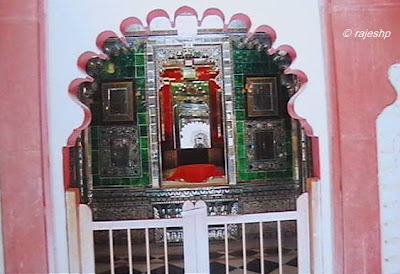 The rooms of the museum are splendidly decorated with painting , tiles and mirrors. One can see exquisite glass and mirror work in the Manak Mahal. Krishna Vilas hosts remarkable collection of the miniatures. The Moti Mahal has beautiful mirror work and the Chini Mahal is covered in ornamental tiles. The Surya Chopar has a huge, ornamental sun-the symbol of Mewar dynasty.
 At Mor Chowk one can see a collection of beautiful mosaics of the peacocks. In the Bari Mahal there is a fine central garden and from this place one can get excellent views of the old city. More beautiful paintings can be seen in the Zenana Mahal.
The entry ticket price to the palace more when compared to any other forts or palaces in Rajasthan. But it is worth as one can witness such beautiful architecture. the Photography is not permitted in Krishna Vilas.
Next we shall see other attractions of the city such as temples and park.
P.S: December is the month when lot of tourists land in Rajasthan. So if you really want all the arrangements to be done properly this has to be done before October end.
 Even though it is built with a single building plan, the architectural brilliance is such that the two wings were built differently. However, the two wings seem to have faultless harmony.
  The carvings on the window are carved out with great precision. The walls are ornamented with stone figurines of horses, flowers, birds, elephants and interesting patterns that resemble extravagant pieces of art.


